After
leaving Logroño, we headed to Bilbao, a beautiful city surrounded by mountains,
twenty minutes from the coast, and home to a branch of the world-famous
Guggenheim museum. Bilbao is the largest city in the Basque Country, an
Autonomous Community of Spain with a very unique and interesting history. Although I had expected to enjoy the city from
people’s descriptions – who wouldn’t love a place with mountains and beaches?
– our time there went far above and beyond my expectations, and made this perhaps my
favorite trip that we’ve taken the entire year! We met so many nice people,
hiked to the top of a mountain with beautiful views and cows roaming free right
beside you, took our shoes off in a museum, watched the sunset over the Bay of Biscay,
and so much more!
Euskadi - The Basque Country
But
before I cover all of the awesome things we did, I want to share a little bit
about the history of the Basque Country, because I find it really interesting and getting to learn about it was one of the many highlights of the trip. Although today it is technically part
of the country we know as Spain, the Basque people have always had their own
distinct identity. Spain has always been a country of great ethnic and cultural diversity, with numerous groups of peoples speaking different languages, practicing different religions and leading divergent ways of life. In the
middle ages, the Iberian peninsula was a hodgepodge of different kingdoms and political zones, each of which had their own culture and language. In large part, these difference are still reflected today in Spain’s division into Autonomous
Communities, several of which still maintain their own cultures and official languages in addition to
Castilian Spanish. For instance, Catalan is spoken in Catalonia, Galician
Portuguese in Galicia, Aragonese in Aragón, Bable in Asturias and Basque in the Basque country.
 |
| Not the most sophisticated map in the world, but it gives a general idea of Spain's diversity |
Throughout the centuries, all of these different peoples have constantly been jostling for independence and power over their own slice of the Iberian peninsula, and the Basques are no exception. However, the Basque peoples' struggle has been particularly pronounced in the past century, beginning with their extreme persecution at the hands of Franco, the military dictator who ruled Spain after the Spanish Civil War. Although they regained most of their independence immediately following his death, this did not quell many Basques' militant nationalist sentiments, and throughout the second half of the twentieth century a terrorist group known as the ETA committed various acts of violence in order to show their discontent and their desire to be independent. While they are not as militant today as they once were, separatist notions are far from absent, and can be seen in things as obvious as demonstrations (we witnessed a very small one while in Bilbao) or in things as subtle as repainting a street sign to assert the Basque spelling of a name over the Spanish spelling.
 |
| The hyper-famous painting Guernica by Pablo Picasso portrays the gruesome bombing of a peaceful Basque town by German forces as ordered by Francisco Franco. It's perhaps the most well-known testament to Franco's cruelty towards the Basque people, and to the horrors of the Spanish Civil War in general. |
The goal in subjecting you to all of this history is really just to show how heterogeneous Spain is, and to help understand how unique and different it felt to be in the Basque Country. The Basque language is one of the strangest ones I've ever seen in my life. The grammar is extremely complex and linguists to this day have not been able to determine any other existing human language to which Basque is related!
 |
| Some pictures of Basque signs around Bilbao |
Bilbao
The city we visited was called Bilbao, and it is the largest city in the Basque Country. I had wanted to go for a long time for the reasons I listed before - it's encircled by mountains and at the same time close by the sea - but we discovered that the city itself was not only lovely and exciting, but has an interesting history of its own. It used to be an extremely ugly, industrial city, with the river polluted and choked by factories and huge exportation outfits. Little money was invested in the upkeep of public buildings, which became dingy and dirty over time, and the city center was blighted by the cropping up of countless impersonal, boxy apartment buildings meant to house the factory workers. It was a gray, dismal, decrepit place, until the construction of a new, groundbreaking building - the Bilbao Guggenheim - put Bilbao on the map, generating a huge influx of revenue from tourism and sparking the economic rejuvenation needed to clean up the city and make it the beautiful, clean, modern place which it is today.
 |
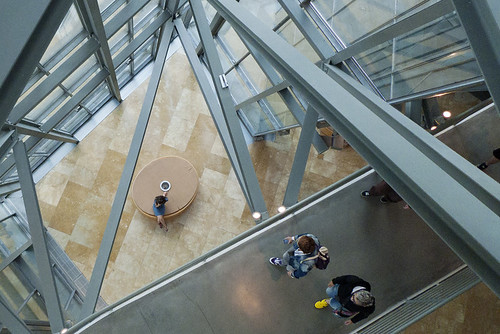
| Some interior and exterior views of the Bilbao Guggenheim |
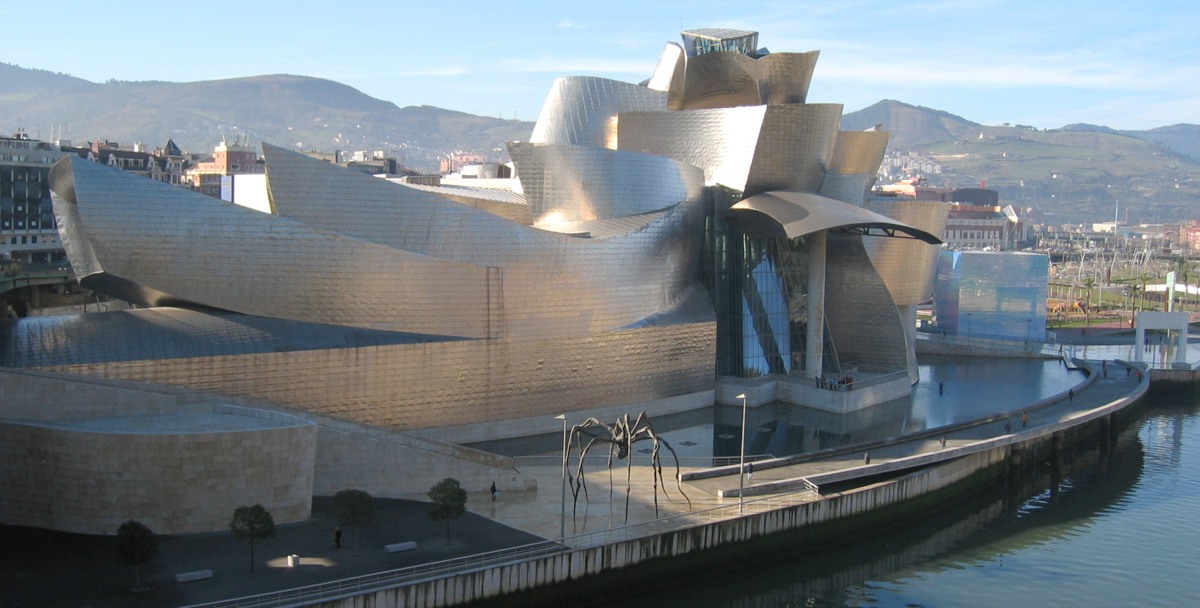
The museum was paid for by the Basque government with these very hopes in mind, and it is clear today that their investments and efforts were well-placed. The building, designed by world-renowned architect Frank Gehry, was instantly hailed as a masterpiece, and its daring, deconstructivist architecture, along with the museum's cutting-edge temporary and permanent collections, quickly brought the tourists which the government had hoped for. I obviously visited the museum during my time in the city and it was indeed pretty incredible. In spite of being on the smaller side as far as museums go, the interior layout is so elaborate and quirky that it's easy to get lost and lose your sense of how large the space around you really is. As you can see from the picture above, there is hardly a single straight wall or right angle anywhere in the building.
 |
| Some pictures from Google, because mine really don't do it justice! |
I was there on the last day of an exhibit by a Brazilian artist named Ernesto Neto that was truly unique. It spanned several rooms and the focus was on interaction with the various senses. Some of the rooms, as you can see in the pictures below, had cloth draped from the ceiling, almost like a tent, with pieces hanging down in which various substances were suspended. In the room with the white tent, which you can see in the pictures below, each piece of hanging cloth was full of a different spice, and as you were allowed to touch any part of the exhibit, you could rub the hanging pouch and your hands would smell like cardamom or cinnamon. There was also a room with a mat made up of tiny strips of fabric which had been woven together running along the edge of the room; I saw little niños running on the carpet and expected the stern security guards to admonish them. When they said nothing, I went up to investigate and saw a sign that, instead of "DO NOT WALK" said "DO NOT WALK WITH SHOES ON." So I took off my hiking boots and joined the niños in trampling Neto's work of art! It was definitely the first time I've ever taken my shoes off in a museum, and it was such a cool experience - it seems that Neto really wanted to challenge the way people think about and interact with art in museums.
 |
| Some of the rooms containing Ernesto Neto's work |
Returning to the history of how Bilbao got to where it is today, as I mentioned before, the museum was only the beginning of a beautification process that eventually revamped the entire city. This renewal was aided by a man named Iñaki Azkuna, the mayor of Bilbao from 1999 until his death earlier this year. The museum may have provided the economic capital needed, but he was the one who really took advantage of it to turn the city into something special. He cleaned up the river and hired artists and architects to create the lovely river walk which you can see in the collage below. Now Bilbao's downtown is a charming, thriving place, where nature, modern and classical architecture come together in a truly unique way. Iñaki's work was recognized when he was named the best mayor in the world by the City Mayor's Foundation in 2013.
 |
| Some views of Bilbao's river walk |
We were able to learn so much about the city's history from a guy named Eder, a native bilbaíno who voluntarily spent the day showing us around and acting as our own personal tour guide. We had messaged him on Couch Surfing when we were trying to find someone to stay with, and while he was unable to offer us a place to stay, he wrote back and said that he would be happy to meet up with us and show us around. We were expecting him to maybe walk us through a bit of the old town, take us to a bar for pintxos (the Basque version of tapas) and call it a day, but he wound up giving us an extremely thorough tour of the entire city center, then driving us in his car out to a picturesque fishing village, and finally taking us to a bar on top of a hill overlooking the Bay of Biscay to watch the sunset. It was incredible, and although we insisted on paying for his drinks and meals everywhere that we went, needless to say we were at a loss of how to repay such kindness. Afterwards we felt so thankful and blown away that someone would go so far out of their way to be so helpful and hospitable.
 |
| A picture of us with our new Basque friend Eder at the top of the cable car in Bilbao |
 |
| Getxo, the beautiful fishing village Eder took us to visit |
 |
| The hilltop bar where we had calimotxo and watched the sunset |
The day after Eder selflessly showed us around, another guy from Couch Surfing - who had likewise been unable to host us but who had offered to hang out anyway - took me and a Brazilian girl I had just met at my hostel to hike up one of the mountains which surround the city. The guy was also Basque - his name was Ander - and he was accompanied by a Polish friend, so we were a truly international group. The Brazilian girl had asked to sit with me at breakfast and we had struck up a conversation; when I mentioned that I was going on a hike with some Couch Surfing guys, she asked a lot of questions and seemed interested, so I asked if she wanted to come. She was in Spain for a conference that was starting in a few days and had come early to travel for a bit, so she appreciated the offer of companionship. She was also a really interesting person; she was involved in social work and apparently collaborated extensively with the mayor of Rio de Janeiro, focusing mainly on issues in the city's many favelas, or slums.
 |
| Some pictures from our hike up Pagasarri |
As the pictures attest, the hike was absolutely beautiful, with incredible views of the rolling mountains all around and the city down below. There were even parts of the trail where cows were grazing untethered at our side, the clanging of their bells reverberating through the air. And, as with the day before, the best part was getting to make a connection and share these experiences with complete strangers. This - combined with our incredible luck in having gorgeous weather both days, when the region is normally submitted to perpetual rain and grayness - was what made this trip so special and one of my favorite ones we made all year. Beginning with our Brazilian hosts in Logroño, the unthinkable generosity of Eder and the cool connections with Rafaela, Ander and Daniel, this trip began to introduce me to the best part of traveling in Europe in this day and age - the ability to harness social media and internet resources to enrich your travels by meeting wonderful people along the way! For this reason, this brief but beautiful weekend in Bilbao will always stand out in my mind.